


Enjoi it!
Showing posts with label Society. Show all posts
Showing posts with label Society. Show all posts
04 October 2011


11 July 2011
A day with Margherita Missoni - Video-interview by VOGUE Germany.
A focus on a Margherita Missoni's typical day, heir to the Missoni's empire, built over many years of great craftsmanship and research.
Take a look. Enjoy it!
Take a look. Enjoy it!
06 July 2011
VALENTINO: State of Grace. Interview.
While we're waiting for photos of latest Valentino's Haute Couture collection, enjoy this article pubblished by Interview.

"If there is something most significant about Valentino, it’s that women feel beautiful when they’re wearing Valentino. Beauty is at the core of his work—it’s not just an element."
Pier Paolo Piccioli
Since taking the reins two and a halfyears ago as creative directors at VALENTINO,designers Maria Grazia Chiuri and Pier Paolo Piccioli have faced numerous challenges—not the least of which has involved building upon the enormouslegacy of the legendary Valentino Garavani, who retired from the house that bears his name in January 2008. Mr. Valentino may have left his business, but he didn’t retreat from the fashion world and certainly not from his very active social life. Today Valentino’s imagecontinues to loom large, both figuratively and literally, over the fashion empire that he and his longtime business partner, Giancarlo Giammetti, built together over the span of nearly five decades.
Chiuri and Piccioli, who had previously served as accessories designers under Valentino for more than a decade, were appointed in 2008 following the brief run of Alessandra Facchinetti, who took over after Valentino’s retirement and promptly moved to etch out a new, very different image for the Valentino woman, but lasted just two seasons at the helm. In stepping in after Facchinetti’s departure, Chiuri and Piccioli were thrust into the position of having to determine the future of a brand at acrossroads. The journey has not been without some bumps along the way: a debut collectionthat some deemed too reverently old-school Valentino; another, an Avatar-inspired collection thatothers deemed not Valentino enough; and their ongoing struggle to carve out their own path as a design team—and working to reconcile that vision with the history of Valentino—in a very public way. Recently, though, Chiuri and Piccioli have started to hit their stride. Their Fall 2011 collection, presented this past March in Paris, offered clear evidence of why they’ve quietly captured the hearts of Young Hollywood’s hippest girls (among them, this month’s cover girl, Michelle Williams, who wore Valentino to the Golden Globes), while creating a new language of grace and fragility in fashion—one that contains a delicate balance of romantic prettiness and edginess that has gently seduced women back into kitten heels, longer lengths, sheer layers, lace, ruffles, and bows—and a lightness of being that is quickly becoming the signature for the Valentino girl of the future.
The day after the show, Chiuri and Piccioli visited Giammetti at Valentino’s castle, Chateau de Wideville, in Davron, a half hour outside of Paris, to discuss the burdens of stepping into the shoes of their former boss, the Last Emperor, and how they think they’ve found a way to the future by looking into the past. Since taking the reins two and a half years ago as creative directors at Valentino, designers Maria Grazia Chiuri and Pier Paolo Piccioli have faced numerous challenges—not the least of which has involved building upon the enormous legacy of the legendary Valentino Garavani, who retired from the house that bears his name in January 2008. Mr. Valentino may have left his business, but he didn’t retreat from the fashion world and certainly not from his very active social life. Today Valentino’s image continues to loom large, both figuratively and literally, over the fashion empire that he and his longtime business partner, Giancarlo Giammetti, built together over the span of nearly five decades.
Since taking the reins two and a halfyears ago as creative directors at VALENTINO,designers Maria Grazia Chiuri and Pier Paolo Piccioli have faced numerous challenges—not the least of which has involved building upon the enormouslegacy of the legendary Valentino Garavani, who retired from the house that bears his name in January 2008. Mr. Valentino may have left his business, but he didn’t retreat from the fashion world and certainly not from his very active social life. Today Valentino’s imagecontinues to loom large, both figuratively and literally, over the fashion empire that he and his longtime business partner, Giancarlo Giammetti, built together over the span of nearly five decades.
Chiuri and Piccioli, who had previously served as accessories designers under Valentino for more than a decade, were appointed in 2008 following the brief run of Alessandra Facchinetti, who took over after Valentino’s retirement and promptly moved to etch out a new, very different image for the Valentino woman, but lasted just two seasons at the helm. In stepping in after Facchinetti’s departure, Chiuri and Piccioli were thrust into the position of having to determine the future of a brand at acrossroads. The journey has not been without some bumps along the way: a debut collectionthat some deemed too reverently old-school Valentino; another, an Avatar-inspired collection thatothers deemed not Valentino enough; and their ongoing struggle to carve out their own path as a design team—and working to reconcile that vision with the history of Valentino—in a very public way. Recently, though, Chiuri and Piccioli have started to hit their stride. Their Fall 2011 collection, presented this past March in Paris, offered clear evidence of why they’ve quietly captured the hearts of Young Hollywood’s hippest girls (among them, this month’s cover girl, Michelle Williams, who wore Valentino to the Golden Globes), while creating a new language of grace and fragility in fashion—one that contains a delicate balance of romantic prettiness and edginess that has gently seduced women back into kitten heels, longer lengths, sheer layers, lace, ruffles, and bows—and a lightness of being that is quickly becoming the signature for the Valentino girl of the future.
The day after the show, Chiuri and Piccioli visited Giammetti at Valentino’s castle, Chateau de Wideville, in Davron, a half hour outside of Paris, to discuss the burdens of stepping into the shoes of their former boss, the Last Emperor, and how they think they’ve found a way to the future by looking into the past. Since taking the reins two and a half years ago as creative directors at Valentino, designers Maria Grazia Chiuri and Pier Paolo Piccioli have faced numerous challenges—not the least of which has involved building upon the enormous legacy of the legendary Valentino Garavani, who retired from the house that bears his name in January 2008. Mr. Valentino may have left his business, but he didn’t retreat from the fashion world and certainly not from his very active social life. Today Valentino’s image continues to loom large, both figuratively and literally, over the fashion empire that he and his longtime business partner, Giancarlo Giammetti, built together over the span of nearly five decades.
28 May 2011
The magic of Milan: behind the scenes could be fun!
 Milan, a place as gritty as it is glamorous, a place where dreams are made and lost. Each year thousands of hopeful designers, stylists, models, and wannabe street style stars flock to the city in hopes of making it big. Fortunately for 24 year old Benedetta Borioni her dreams came true. In January 2010 Borioni was just your average student in Milan with fashion aspirations. Right before Men’s Fashion Week a friend asked her if she wanted to take her place as a model dresser at the Costume National show. Borioni jumped at this opportunity as most of us would have in hopes of meeting her favorite model. After it was all said and done she realized that she actually had enjoyed the work. I asked her what she loved about it. “I like being a model dresser because I’ve met a lot of great people, stylists, models and I’ve got a lot of new friends!” says Borioni. Her favorite part of the whole experience? “You can live the backstage with all the things like panic, photographers, people screaming, people smiling, hair and makeup, the collection before models doing the catwalk and the designers face at the end of the show. What a gratification!” The experience she describes is every fashionistas dream. The backstage is a world rarely seen by people not directly involved in the show and seeing the work that goes into what you see coming down the runway in its perfect presentation, makes you appreciate it even more.
In November 2010 Benedetta found an agency and was an official model dresser for fashion week. Since then she has worked everything from Moschino to Salvatore Ferragamo dressing the likes of Abbey Lee Kershaw, Arizona Muse, Alex Dunstan Alex DunstanAlex Dunstanand Aiden Andrews.
One of her favorite moments she fondly remembers was at FW '11, checking the runway and walking down the catwalk with the music as if she herself was modeling. She says she was so happy she felt like crying. To some people that would seem silly but to fashionistas everywhere that would be a dream come true.
I asked Benedetta what her favorite things about working in the fashion industry are. “I guess the beauty of the things, the creativity of the people and learning a lot as a person and for your work” Her least favorite? “People feel like they’ve got all the power in the world” No explanation for what she means there. We’ve all heard the stories of the taskmaster designer or the pumped up PR.
Milan is a very fickle city in all aspects from fashion, to weather, to nightlife. Most people have a love/hate relationship with the city and Benedetta is no exception. “In order to find something beautiful of Milan you have to know it slowly. You can find everything you want, amazing parties, gigs, and art” she explains. The downside of life in the fashion capitol of the world is the lack of the sea that she loves, the (unbearably hot and crowded) summer, and the difficulty of meeting good people.
I asked Benedetta what her favorite things about working in the fashion industry are. “I guess the beauty of the things, the creativity of the people and learning a lot as a person and for your work” Her least favorite? “People feel like they’ve got all the power in the world” No explanation for what she means there. We’ve all heard the stories of the taskmaster designer or the pumped up PR.
Milan is a very fickle city in all aspects from fashion, to weather, to nightlife. Most people have a love/hate relationship with the city and Benedetta is no exception. “In order to find something beautiful of Milan you have to know it slowly. You can find everything you want, amazing parties, gigs, and art” she explains. The downside of life in the fashion capitol of the world is the lack of the sea that she loves, the (unbearably hot and crowded) summer, and the difficulty of meeting good people.

To many on the outside the world that Benedetta Borioni now lives in seems like a fashion fairytale, with its fun, glamour and crazy model filled after parties, it seems so out of reach but she insists it’s not. To people aspiring to make their way into the fashion world she says all it takes is “passion, patience, strength, and to be in the right place at the right time”. I can say from experience, she’s got it right. Passion is what drives the kids here to spend their free time sewing and creating outfits to wear, patience to wait outside the venues in the rain during fashion week to glimpse the latest runway creations, strength to wait for hours in tragically chic and avant garde creations outside The House of Bordello on a Saturday night in hopes of seeing their favorite designers and to be immortalized in the weekly party pictures. Milan is a truly unique city filled with some of the most creative people in the world. It’s a place where dreams do come true, just ask Benedetta Borioni.
19 May 2011
Shu He for V magazine.


Shu He for V Mazagine #71, Asia summer issue 2011. Shot by Glen Luchford, styled by Beat Bollinger with Make up & hairstyle by Eugene Souleiman & Lucia Pieroni.
18 May 2011
Adele for OUT's cover - June issue 2011.

13 May 2011
Report from Cannes: the best & worst dressed from redcarpet, Day #1.
Every May, the whole population in Cannes rises dramatically as Hollywood comes to town in the form of the Cannes Film Festival. The world-famous and truly iconic Cannes Film Festival is the city's biggest and brightest event of the year, attracting thousands of spectators, film crews and, of course, large numbers of celebrities and movie stars.
And not only is the French festival a great place for new films to make a big splash in front of a global audience, it’s also one of the hottest red carpets of the year.
Check out our picks for the best and worst dressed of the festival.
The best.
We’ve kindly picked out the best dressed celebrities at this year’s festival and first up is Uma Thurman who looked absolutely glowing in two different white dresses. The first was a three quarter length sleeved, lace print Dolce & Gabbana which looked great in the glow of the sun, but she managed to kick it up a notch with another spectacular white gown in the evening. The actress changed into a slinky Versace gown featuring a skirt of feathers, accessorizing with an emerald Chopard bracelet and 54 carat white gold and emerald earrings by the label. Uma Thurman is a jury member for the Cannes Film Festival this year, which means we'll be seeing plenty of her looks.
And not only is the French festival a great place for new films to make a big splash in front of a global audience, it’s also one of the hottest red carpets of the year.
Check out our picks for the best and worst dressed of the festival.
The best.
We’ve kindly picked out the best dressed celebrities at this year’s festival and first up is Uma Thurman who looked absolutely glowing in two different white dresses. The first was a three quarter length sleeved, lace print Dolce & Gabbana which looked great in the glow of the sun, but she managed to kick it up a notch with another spectacular white gown in the evening. The actress changed into a slinky Versace gown featuring a skirt of feathers, accessorizing with an emerald Chopard bracelet and 54 carat white gold and emerald earrings by the label. Uma Thurman is a jury member for the Cannes Film Festival this year, which means we'll be seeing plenty of her looks.
 Uma Thurman paired her little white dress by Dolce & Gabbana with silver Jimmy Choo heels. And then with a Versace withe gown.

Rachel McAdams wore a Marchesa look from the fall 2011 collection for the premiere of Midnight in Paris. The red silk organza illusion cap sleeve dress featured embroidery and a tulle ruffle skirt.

Model Karolina Kurkova chose an Armani Privè fall 2009 gown embroidered with sequins and Swarovski crystals.
The worst.
Unfortunately for most of the stars on the red carpet, there were a lot of bad dresses. Here are the absolute worst.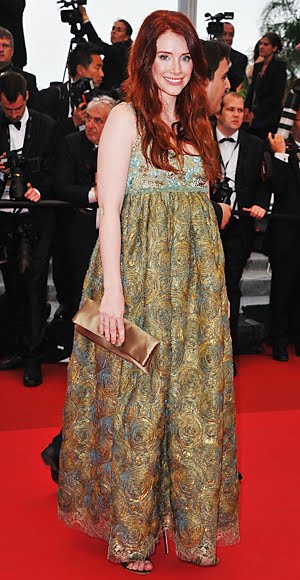
Bryce Dallas Howard wore an empire waist Reem Acra gown to the Sleeping Beauty premiere.
 Salma Hayek chose Gucci's cognac soft leather strapless dress with organza shrug embroidered with hand painted flowers for a photo call for Puss in Boots. She finished the look with a purple lizard belt, tan ostrich platform pumps, and a paprika-colored Gucci top-handle bag.
 Rachel McAdams in Monique Lhuillier. This is Cannes Film Festival so therefore it’s not too much to ask for all the female celebrities to wear a gown.
Style choices by Vesna Filipovic aka Fashionela.
From the desk of Lady Gaga: the game-chancing singer on her many mondrians.
 Glam culture is ultimately rooted in obsession, and those of us who are truly devoted and loyal to the lifestyle of glamour are masters of its history. Or, to put it more elegantly, we are librarians. I myself can look at almost any hemline, silhouette, beadwork, or heel architecture and tell you very precisely who designed it first, what French painter they stole it from, how many designers reinvented it after them, and what cultural and musical movement parented the birth, death, and resurrection of that particular trend. So dear critics and bullies: get your library cards out, because I’m about to do a reading.
An expertise in the vocabulary of fashion, art, and pop culture requires a tremendous amount of studying. My studio apartment on the LES, quite similar to many of my hotel suites now (knock on wood), was covered in inspiration. Everything from vintage books and magazines I found at the Strand on 12th Street to my dad’s old Bowie posters to metal records from my best friend Lady Starlight to Aunt Merle’s hand-me-down emerald-green designer pumps were sprawled all over the floor about two feet from my bathroom and four inches from my George Foreman Grill. (Starlight was always jealous that mine had a bun warmer and hers didn’t.) And in my downtime, which meant whenever I wasn’t waitressing, go-go dancing, or making mixtapes for a music publishing company in Times Square, I was analyzing and studying my library. I would dream of being a rock star who dressed like Mark Bolan, walked like Jerry Hall, and had the panache of Ginger from Casino and the mystery of Isabella Blow.1 See footnote.
Any writer, or anyone for that matter, who doesn’t understand the last two sentences of this column should NEVER be writing about or critiquing fashion or artists in publication. As someone who references and annotates her work vigilantly, I am putting all of you on notice. I’ve done my homework, have you? Where are your library cards? Did they expire? When Yves Saint Laurent designed the “Mondrian” day dress for fashion week Fall/Winter 1965, did he plagiarize or revolutionize? Some people would say he was unoriginal, that he traced an iconic contemporary artwork by Piet Mondrian, and stole it for his own merits. Others may argue that by referencing something so “before its time,” he influenced an entire generation in fashion that transformed the female body with a more linear sensibility, graphics, and painterly shape. We now call it “mod.” Picasso said, “Good artists copy; great artists steal.” Maybe he only said that because he and Matisse were in a bitchy queen fight for two decades (some called it a boxing match, I call it a conversation in art). But maybe it’s just that the resolution is: art gives birth to new art. There is no chicken or egg. It’s molecular. Cells give birth to cells. To put it more bluntly, the Hussein Chalayan vessel I wore at the Grammys wasn’t inspired by a chicken. It was stolen from an egg. But the transformation, the context, and the approach taken to reinterpret the meaning of birth and rebirth in terms of fame on a fucking red carpet — this is what creates the modernity of the statement. The past undergoes mitosis, becoming the originality of the future.
The Haus of Gaga, my (our) own pop-cultural family and living Warholian factory, talked endlessly about the initial vision for “Born This Way.” On the set of the video, it was almost terrifyingly important to me that I tribute Rico (the Zombie Boy’s) tattoos, creating a visual metaphor where tattoos, along with the body modification I had been exploring, became a subcultural symbol for rebirth. Rico in this case was my Mondrian. After I put the makeup on, I found myself dancing and flailing at 9 a.m., after twenty-four hours of no sleep on set. Feeling young and free, it occurred that the makeup allowed me to erase the public’s perception of my beauty, and define it for myself. I asked Rico, “Why did you tattoo yourself this way?” (Something I imagine he’s asked quite frequently.) He said very genuinely, with no hesitation, “Bazooka gum.”2 See footnote.
And just like that, as many of the creations in my brain take form, I realized, and so did the Haus, that not only did I need to reunite with my youth, i.e. “Bazooka gum,” but that my fans needed to see me in that juvenile way in order to understand the intention behind why I wrote “Born This Way.” Accompanied with a side ponytail, it took me back to moments when I was just a little baby monster. When my mother would perch a pony high on my hair and we would dance so hard to the tape deck that the perfectly perched pony she fashioned would fall to the side. I had to take an uncomfortable journey back into high school, where my youth represented tears. Wishing I had a mask. Hoping that I could artistically hide the wounds buried deep from years of being bullied. I have since reckoned with this psychology in my performance art. But this time, the revelation was clear: I still want to wear the mask, but now I wear it proud, and with the same effervescence and innocence I had when I was 6, dancing with my mom.
After I performed “Born This Way” at the Grammys, it seemed as though the piece was interpreted as an engagement for battle. And the whole performance was a battle cry in essence — for freedom against forces of inequality and prejudice. But as quickly as the song catapulted to number one, a more subtle controversy exploded. “Born This Way” was a triumph as a pop song and a social statement, but it ultimately revealed another division: the reality that the young generations’ challenges with equality and social justice are just as prevalent now as they were twenty-five years ago. And while “Born This Way” was written for every walk of life, I began to feel my youngest fans were longing to be nurtured, while others felt they already had been. Perhaps in this way the song was not for everyone, although the intention was such. And perhaps I was naïve to hope everyone would unfold the true meaning of my performance piece the way I unfolded YSL’s “Mondrian” dress. Instead, I am caught between two forces: one holding onto a ponytail, and another screaming “I don’t want to be angry, I want to be free.”
“I DON’T WANT TO BE A DRAG, I JUST WANT TO BE A QUEEN.”
I have a passionate understanding of the history of many of the references that not only I have reinspired, but have been reinterpreted over centuries of fashion: where they came from, what they meant, and specifically how they became modern again. I have concurrently shown that I could “read you” in this subject, but I would rather reckon with the fact that many are clinging tightly to cultural divisiveness and leaving home without library cards.
Just like sometimes Picasso was Matisse’s Mondrian, and vice versa. Bowie is often my Mondrian, as are Michael Jackson, Prince, Lita Ford, and Madonna. Mugler is my silhouette’s Mondrian, Cindy Crawford is my sexuality’s, Kermit is my whimsy’s, and, in my “Born This Way” video, two of my Mondrians were Francis Bacon and Salvador Dalí. In a lot of ways the “idea” of being obsessed with art is my Mondrian. Just like Campbell’s Tomato Soup was Warhol’s Mondrian, and Marilyn Monroe and Maripol were Madonna’s. I am obsessed with all the authors in the library of pop culture.
I do not define, however, my artistry or historical relevance with one particular fashion or musical statement. And I don’t believe any of the artists I mentioned do either. Rather, I find freedom in my ability to transform and liberate myself (and others) with art and style — because those are the things that freed me from my sadness, from the social scars. Furthermore, I am in no way encouraging anyone to emulate my fashion sense, but rather setting a, hopefully, liberating example for anyone to look inside and know they can become any image or projection imaginable. I am an obsessed pop cultural expert. And, perhaps, between my music, performance art, and this column, I will be remembered as such. After weeks of writing this article I asked out loud, “What do you think YSL would think of my metaphor about his collection?” My darling hair designer Frederic replied, “You could ask Nan Kempner, but she’s dead.” Now that’s a queen who never left home without her library card.
1. Mirrored bikini inspired by Bolan Scuba Suit, Mugler runway model walk, a past romance with drugs and costume jewelry à la Scorsese. Lobster Philip Treacy hat.
2. For those of you who’ve never had it, it’s a retro chewing gum that comes with whimsical stick-on temporary tattoos.
After I performed “Born This Way” at the Grammys, it seemed as though the piece was interpreted as an engagement for battle. And the whole performance was a battle cry in essence — for freedom against forces of inequality and prejudice. But as quickly as the song catapulted to number one, a more subtle controversy exploded. “Born This Way” was a triumph as a pop song and a social statement, but it ultimately revealed another division: the reality that the young generations’ challenges with equality and social justice are just as prevalent now as they were twenty-five years ago. And while “Born This Way” was written for every walk of life, I began to feel my youngest fans were longing to be nurtured, while others felt they already had been. Perhaps in this way the song was not for everyone, although the intention was such. And perhaps I was naïve to hope everyone would unfold the true meaning of my performance piece the way I unfolded YSL’s “Mondrian” dress. Instead, I am caught between two forces: one holding onto a ponytail, and another screaming “I don’t want to be angry, I want to be free.”
“I DON’T WANT TO BE A DRAG, I JUST WANT TO BE A QUEEN.”
I have a passionate understanding of the history of many of the references that not only I have reinspired, but have been reinterpreted over centuries of fashion: where they came from, what they meant, and specifically how they became modern again. I have concurrently shown that I could “read you” in this subject, but I would rather reckon with the fact that many are clinging tightly to cultural divisiveness and leaving home without library cards.
Just like sometimes Picasso was Matisse’s Mondrian, and vice versa. Bowie is often my Mondrian, as are Michael Jackson, Prince, Lita Ford, and Madonna. Mugler is my silhouette’s Mondrian, Cindy Crawford is my sexuality’s, Kermit is my whimsy’s, and, in my “Born This Way” video, two of my Mondrians were Francis Bacon and Salvador Dalí. In a lot of ways the “idea” of being obsessed with art is my Mondrian. Just like Campbell’s Tomato Soup was Warhol’s Mondrian, and Marilyn Monroe and Maripol were Madonna’s. I am obsessed with all the authors in the library of pop culture.
I do not define, however, my artistry or historical relevance with one particular fashion or musical statement. And I don’t believe any of the artists I mentioned do either. Rather, I find freedom in my ability to transform and liberate myself (and others) with art and style — because those are the things that freed me from my sadness, from the social scars. Furthermore, I am in no way encouraging anyone to emulate my fashion sense, but rather setting a, hopefully, liberating example for anyone to look inside and know they can become any image or projection imaginable. I am an obsessed pop cultural expert. And, perhaps, between my music, performance art, and this column, I will be remembered as such. After weeks of writing this article I asked out loud, “What do you think YSL would think of my metaphor about his collection?” My darling hair designer Frederic replied, “You could ask Nan Kempner, but she’s dead.” Now that’s a queen who never left home without her library card.
1. Mirrored bikini inspired by Bolan Scuba Suit, Mugler runway model walk, a past romance with drugs and costume jewelry à la Scorsese. Lobster Philip Treacy hat.
2. For those of you who’ve never had it, it’s a retro chewing gum that comes with whimsical stick-on temporary tattoos.
Powered by V Magazine.
03 May 2011
McQueen: Savage Beauty. Behind-the-Scenes.
McQueen: Savage Beauty on Nowness.com.
A Behind-the-Scenes Look at a Highlight From the Designer's Costume Institute Retrospective.
A collaborative labor of love between late designer Lee Alexander McQueen, milliner Philip Treacy and jeweler Shaun Leane, the Bird's Nest Headdress profiled in today's film is among the pieces appearing in the Costume Institute of New York's McQueen retrospective at the Metropolitan Museum of Art opening this week. "Birds were one of McQueen's greatest inspirations," says curator Andrew Bolton. "This hat is a poetic manifestation of his love of nature." The feathered creation opened McQueen's fall 2006 Widows of Culloden presentation, a darkly romantic panoply of tweeds, tartans and brocades inspired by the final battle of the Jacobite Risings that saw the fashion maverick revisit his Scottish roots. Crafted from mallard wings, Swarovski blue topaz and smoky quartz gemstones, the headwear took eight weeks to complete and was one of two works the trio of designers made together for Widows—the other being a black spinel–encrusted eagle's skull topped with jet plumes. "McQueen gave me the platform to push the boundaries of jewelry design," says Leane. Savage Beauty will feature close to 100 looks and 70 accessories pulled from McQueen's 19-year body of work, spanning his pivotal early collection Highland Rape to his swan song in 2010, when royal wedding dress designer Sarah Burton took up the McQueen mantle.
Fashilosophy's best of the MET Gala 2011.
Last night at the Metropolitan Museum, was celebrated the annual Gala of the Costume Institute, this year dedicated to the genius of Alexander McQueen. Watching and commenting about redcarpet we have decreed the our three best outfits.

At first position we put doubtless a beautiful Jessica Stam dressed by Tommy Hilfiger's blush pink strapless dress. Elegant and refined, make up and coiffed like a fairytale princess. She catch our hearts!
At second position we put an androgynous Hilary Rhoda, dressed by a beautiful and fresh Alexander McQueen's white dress-suit. A vintage hairstyle and red lipstick transforming this beautiful woman in a new Greta Garbo.
At third position we put an always wonderfully classy Natalia Vodianova, dressed by a vintage Haute Couture creation of her accompanist for the Gala, Mr. Valentino. This dress belongs to the collection that the couturier created for his 45 years carrer show, in Rome.
According Fashilosophy these are the three most beautiful and elegant mises of the Gala. But amid so much beauty can't go unnoticed even bad taste: Naomi Campbell, the Black Venus historic character of the most famous catwalks, came to the gala with a questionable outfit. Dress by Alexander McQueen was amazing, but she looks kitsch, old and grotesque at the same time. Naomi NO! From you we can't accept it!
30 April 2011
Who has dressed who! The most photographed (and criticized) outfits!
 HM Queen Elizabeth II in Angela Kelly.
Lady Carol Elizabeth Goldsmith in Catherine Walker (a griffe loved by Princess Diana too).
 Victoria Beckham in a dress of her latest collection, with Philip Treacy's hat and shoes of Christian Louboutin; accompanied by David Beckham in Ralph Lauren.
HRH Crown Princess Victoria of Sweden in Elie Saab.
 The York's sisters: HRH Princess Eugenie in Vivian Westwood, and her sister HRH Princess Beatrice in Valentino Maison with a hat by Philiph Treacy.
HRH Princess Maxìma of the Netherlands in Valentino Couture.
Philippa Middleton in a vintage dress of Alexander McQueen.
29 April 2011
Prince William and Miss Catherine. Royal weeding date.


One of the first official pictures of the function at Westminster Abbey's nave. Catherine Middleton wear a bride dress designed by Sarah Burton at Alexander McQueen. HRH Prince William wears the traditional Irish high uniform suit, as tradition.
Credict of Pic: TIME magazine.

Miss Catherine, now Duchess of Cambridge, in Sarah Burton at Alexander McQueen dress for the evening. Amazing, sleek and timeless elegance.
Credits of pic: Photo by John Stillwell - WPA Pool/Getty Images 2011.
28 April 2011
Olivier Rousteing new Creative Director of BALMAIN!
 As the newly crowned creative director of Balmain, you can imagine my surprise when seeing the image of Olivier Rousteing and thinking, ‘why is he not a model?’.
 Interesting is the fact that the house of balmain announced last week that a new talent would come to the forefront, someone who was not known to the masses & it seems as though a new revitalization of the french fashion house is waiting in the wings. rousteing has already attained experience working at Roberto Cavalli for 5 years & was promoted to head of design for both men & women’s ready-to-wear. Rousteing has risen through the ranks while being in charge of womenswear at Balmain since 2009. while some forms of hesitation are felt on my part, given the redundancy of design seen from balmain for the last few seasons- im more than eager to see how rousteing’s vision will allow the label to transform. prior to his work in the industry, Olivier had completed studies of fashion design at paris’ école supérieure des arts et techniques de la mode in 2003. French-born, it seems only fitting that olivier take the wheel at the legendary fashion house, that has been in existence since 1945, which expanded stateside in 1951. much like Sarah Burton to Alexander McQueen, Rousteing was reportedly key deputy to Christophe Decarnin & is more than likely is the best fit for the position. exciting new prospects & more for us to watch on the runway. with show season nearly six months away, im sure im not the only one who will be waiting with bated breath. word to Balmain; save some coins & cast olivier for your Balmain homme campaign.
Così come l'appena incoronato Creative Director di Balmain, potete immaginare la mia sorpresa nel vedere l'immagine di Olivier Rousteing, che mi ha fatto pensare: Perché lui? Non è un modello?. interessante è il fatto che la storica griffe Balmain aveva annunciato la scorsa settimana che un nuovo talento sarebbe venuto alla ribalta, qualcuno che non era molto noto alle masse, chiamato per il nuovo rilancio della casa di moda francese, era in attesa dietro le quinte. Rousteing ha già avuto una discreta esperienza da Roberto Cavalli, dove ha lavorato per 5 anni alla direzione prêt-à-porter donna e uomo, e pur essendo alla direzione womenswear di Balmain dal 2009 è cresciuto all'ombra del direttore creativo uscente. Nonostante qualche esitazione da parte mia, data la ridondanza del concept Balmain dell'ultimo paio di stagioni, sono impaziente di vedere come la visione Rousteing permetterà di trasformare questa griffe. Olivier prima del suo lavoro nel settore, ha completato gli studi in fashion design alla École supérieure des arts et techniques de la mode nel 2003 a Parigi. Francese di nascita, mi sembra giusto che sia lui a prendere il testimone della leggendaria maison, fondata nel 1945, e approdata negli States nel 1951. Come per Sarah Burton da Alexander McQueen, Rousteing è stato l'assistente principale di Christophe Decarnin, ed era quindi più che probabile la sua scelta per questa posizione di rilievo. Emozionanti nuove prospettive quindi.
Powered by JEREMIDANTE
Così come l'appena incoronato Creative Director di Balmain, potete immaginare la mia sorpresa nel vedere l'immagine di Olivier Rousteing, che mi ha fatto pensare: Perché lui? Non è un modello?. interessante è il fatto che la storica griffe Balmain aveva annunciato la scorsa settimana che un nuovo talento sarebbe venuto alla ribalta, qualcuno che non era molto noto alle masse, chiamato per il nuovo rilancio della casa di moda francese, era in attesa dietro le quinte. Rousteing ha già avuto una discreta esperienza da Roberto Cavalli, dove ha lavorato per 5 anni alla direzione prêt-à-porter donna e uomo, e pur essendo alla direzione womenswear di Balmain dal 2009 è cresciuto all'ombra del direttore creativo uscente. Nonostante qualche esitazione da parte mia, data la ridondanza del concept Balmain dell'ultimo paio di stagioni, sono impaziente di vedere come la visione Rousteing permetterà di trasformare questa griffe. Olivier prima del suo lavoro nel settore, ha completato gli studi in fashion design alla École supérieure des arts et techniques de la mode nel 2003 a Parigi. Francese di nascita, mi sembra giusto che sia lui a prendere il testimone della leggendaria maison, fondata nel 1945, e approdata negli States nel 1951. Come per Sarah Burton da Alexander McQueen, Rousteing è stato l'assistente principale di Christophe Decarnin, ed era quindi più che probabile la sua scelta per questa posizione di rilievo. Emozionanti nuove prospettive quindi.
Powered by JEREMIDANTE
27 February 2011
Faster, Mugler! Kill Kill!
 One Shot #6
"Fashion is a movie. Every morning when you get dressed, you direct yourself."
Thierry Mugler, 2011.
The unsaid is very important.
Futurism is the unsaid, the unexpected. No codes, completely open and full of charm. It's movement and evolution. Dada and Futurism allow sensations to be evoked, emotions to be awaken. It's true, the world gets formatted, trivialized everyday more but when facing with the unsaid, taboos are ready for us to hold on to.
Get some humor, world! Here's to you the infamous Mr Misogyny par excellence: Thierry Mugler. Yet Femininity has never been celebrated in such a way. Heavily criticized during his whole career for the not-so-comfortable styling and fitting ("…je veux une femme roulèe comme une Buick!"), Mugler simply elevates the Woman to a pagan goddess. The body becomes a hybrid, a machine that never stops changing shape. The limits between dress and model's body do not exist anymore. The designer's sources include sexual fetishism, politics, sci-fi, Metropolis, Hollywood glam. A newly revamped Sunset Boulevard takes place during Mugler's shows, like Cirque d'Hiver is showing (1995). Dada and Futurism seem to be the pattern influencing the designer's approach to fashion: detail, transformation, theatrics, communication.

The woman is touched with idolization and devotion by his hands and the way he conceptualized femininity is nothing like the others. McQueen also pushed the Woman to fight against herself, against society, against men, against history. Remember the whole Highland Rape thing by McQueen? It was history en scène, it was the epic representation of a civilization. Let's imagine John Willies' work alive: a third body is created when the model dresses the strong, living clothes by Thierry Mugler. (robot)
Dealing with history, the broad-shouldered collection of 1986, for example, was inspired by Russia. Visuals of the performance-show included backgrounds of heroic Soviet monuments mixed with endless landscapes reminiscent of early 20th-century Social Realist painting and poster art. The kaleidoscopic compositions he created represent myth and truth, Chimere (1998) and Hollywood ladies, Gothic Velvet Vampires (1988) and Cow-girls (1992). Mugler's work as photographer also is a clear-cut definition of how his Goddess should be portrayed.
In his words, the unsaid is very important. Muglerettes would agree, I'm sure.
Hold on tight to taboos, world!
Spread the word!

"La moda è come un film. Ogni mattina quando ti alzi scegli cosa indossare, stai mettendo in scena te stesso."
Thierry Mugler, 2011.
Ciò che non diciamo spesso è più importante delle nostre parole. Il Futurismo rappresenta il non detto, l'inaspettato. Privo di codici, è totalmente aperto e affascinante. E' movimento, evoluzione. Dada e Futurismo rivelano sensazioni, emozioni celate. E' vero, non è più così facile lasciarci sorprendere: il mondo diviene ogni giorno più omologato, semplice, ma quando veniamo in contatto con il non detto i nostri tabù porgono una mano a cui aggrapparci. Per paura.
Procuratevi un sano sense of humour, signore e signori! Ecco a voi Mr Misoginia in tutto il suo splendore: Thierry Mugler. Eppure la Femminilità non è mai stata celebrata così. Da sempre criticato per i suoi fitting non propriamente agili ("…je veux une femme roulèe comme une Buick!"), Mr Mugler semplicemente eleva la Donna allo status di divinità pagana. Il corpo è un ibrido, una macchina in continua evoluzione di forma. Il confine tra abito e corpo non esiste più. Pensiamo alle fotografie di John Willie: le sue modelle, legate con corde e lacci divenivano la somma di corda e corpo, un terzo soggetto nasceva nei suoi scatti. Il designer si lascia influenzare dalla moda fetish (1989), dalla politica, dalla science-fiction, dai grandi film del passato, da Metropolis ai grandi capolavori di Hollywood. Un nuovo "Viale del tramonto" viene messo in scena in Cirque d'Hiver (1995). Dada e il Futurismo sembrano essere la chiave per comprendere le creazioni di Mugler: dettaglio, trasformazione, teatralità, comunicazione.
L'artista tocca la Donna con adorazione e devozione, viene plasmata in modo completamente nuovo, unico. McQueen allo stesso modo spinge la Donna a lottare contro stessa, la società, la storia, a divenire guerriera, strega. Ricordate il celebre Highland Rape di McQueen? Era una messa in scena storica, l'epica rappresentazione di una civiltà.
La storia? Mugler lavora ad una collezione di ispirazione russa nel 1986. Spalle ampie, alte, geometrie severe. Il background mostra gli eroici, imponenti monumenti sovietici e grandi paesaggi ispirati alla pittura realista socialista degli anni '20. Il caleidoscopio di Thierry Mugler crea mito e verità, Chimere (1998) e dame hollywoodiane, Gothic Velvet Vampire (1988) e Cow-girls (1992). Anche il suo lavoro come fotografo esplicita una lucida visione della sua Donna, l'unico modo in cui una divinità deve essere ritratta.
Per dirlo a suo modo, ciò che non diciamo è molto importante. Tutte le Muglerettes sarebbero d'accordo.
Tenevi stretti i vostri tabù!
Spread the word!
Tommaso Pollo's "One Shot" for Fashilosophy!
21 February 2011
Daphne Guinness video-interview for VOGUE.IT!
ICONIC!
Bernard-Henri Levi once said about her: "You're not a person, you become a concept." This is true. Daphne's a factory of ideas.
19 February 2011
01 February 2011
Style Icon of the month #7
 Style Icon of the month: Kate Lanphear.
She's the style director of ELLE US and is originally from Virginia but started her career in fashion in Australia. The style editor is known for her strong sense of dress, platinum blonde locks and is often revered as a style icon by those in the industry. Kate has a huge cult following and has inspired numerous blogs that follow her punky style.
Previous to working in the United States, Kate worked for eight years in Sydney at Vogue AU and Harper's Bazaar AU. She then returned to the USA where she landed a role at Harper's Bazaar. It wasn't long before she was offered the role of senior fashion editor at Elle and then style director in 2008.
She was raised in a conservative Irish-Catholic family and was surrounded by stylish women. She says her own wardrobe is filled with studs, chains and black skinny jeans. Kate's style is both androgynous and glamourous. Although she thinks of herself as a fashion geek, claiming her style is more "potluck".
Although Kate herself has worked for years in fashion, she likes that there are fresh voices in fashion through blogging and the internet.
As for favorite designers, Kate says that she collects old Helmut Lang and Margiela.
She really rocks in fashion!
27 January 2011
Reports from Paris: Armani Privé and Dior Haute Couture Printemps/Été 2011. You can do better!
I do not know, but I think this Couture Parisienne's season has started with a bit difficulty. Giorgio Armani proposed a strange woman, but a "strange at all costs" that poorly suited to his philosophy, philosophy for some years, mainly in couture label, has lost the historical concept of Re Giorgio, referring to the worlds maybe too far from him. A mix of a classic Armani and a sperimentale-futuristic Armani failed badly. Surely some catwalk-outfit proposed is wonderfully appealing, but if you look at the entire collection, all in one breath, you hear a false note.
Tim Blanks says 'bout him "Inspired, he said, by the gleam of gemstones, Armani produced clothes that came from another planet, the same one that Pier Cardin and Thierry Mugler might have touched down on once. (It's already been suggested its name could be Gaga.) The first outfit—jacket, skirt, and leggings—shimmered around the model's body like liquid mercury. Her metallic saucer of a hat—one of many made by Philip Treacy for the collection—beamed in signals from above. The ensemble set the tone for the sci-fi extravaganza that followed. "Tron-y, a bit," said Wilde, who should know."
Thierry Mugler is the Armani's inspiration? That's unusual, but grant to sacred god of fashion to have fun...sometimes.
Tim Blanks says 'bout him "Inspired, he said, by the gleam of gemstones, Armani produced clothes that came from another planet, the same one that Pier Cardin and Thierry Mugler might have touched down on once. (It's already been suggested its name could be Gaga.) The first outfit—jacket, skirt, and leggings—shimmered around the model's body like liquid mercury. Her metallic saucer of a hat—one of many made by Philip Treacy for the collection—beamed in signals from above. The ensemble set the tone for the sci-fi extravaganza that followed. "Tron-y, a bit," said Wilde, who should know."
Thierry Mugler is the Armani's inspiration? That's unusual, but grant to sacred god of fashion to have fun...sometimes.


Then John Galliano for Christian Dior disappoint us season by season. Ok, we understand that your style-sign is the extravagance and excess, the provocation... but we got to 2011, after fourteen years the overlaps of volumes, skirts with layers and layers of tulle like bar suit, the make-up so excessive as to make the models look like newyorker dragqueens has a little tired us. From a genius of the illussione as Galliano (for a so important maison like Dior) is always expected something more than a constant mention of himself. Obviously that's just my opinion, questionable or not, but you must admit that this collection isn't nothing of new and amazing, only the craftsmanship with which it was created, that isn't a news. Going without fail can be a wise choice these days, but you can be true to yourself without stumbling into the "already seen and reviewed".


Non so, ma credo che questa stagione della Couture Parisienne sia partita davvero a fatica. Armani propone una donna strana, ma di quello strano a tutti i costi che poco si addice alla sua filosofia, filosofia che già da qualche anno, soprattutto nella couture, ha perso il concept generale di Re Giorgio, rifacendosi a dei mondi forse troppo distanti da lui. Un mix tra un Armani futuristico-sperimentale e un Armani classico poco riuscito. Sicuramente qualche proposta passerella è meravigliosamente invitante, ma se si osserva tutta la collezione, tutto d'un fiato, si avverte una nota stonata. Tim Blanks ha scritto circa questa collezione: "Inspired, he said, by the gleam of gemstones, Armani produced clothes that came from another planet, the same one that Pierre Cardin and Thierry Mugler might have touched down on once. (It's already been suggested its name could be Gaga.) The first outfit—jacket, skirt, and leggings—shimmered around the model's body like liquid mercury. Her metallic saucer of a hat—one of many made by Philip Treacy for the collection—beamed in signals from above. The ensemble set the tone for the sci-fi extravaganza that followed. "Tron-y, a bit," said Wilde, who should know". L'ispirazione di Re Giorgio è Thierry Mugler? Beh questo è davvero inusuale, ma concediamo ad un dio sacro della moda di divertirsi...ogni tanto.
John Galliano per Christian Dior poi, mi delude di stagione in stagione. Ok, abbiamo capito che il tuo segno di stile è la stravaganza e l'eccesso, la provocazione...ma siamo arrivati al 2011, dopo quattordici anni le sovrapposizioni di volumi, le gonne a ruota con strati e strati di tulle stile abito bar, il trucco così eccessivo da far sembrare le modelle delle dragqueens californiane ci ha un po' stancati. Da un genio dell'illussione come Galliano (per una maison così importante come Dior) ci si aspetta sempre qualcosa di più e non una costante citazione di se stesso. Ovviamente è solo una mia opinione, discutibile o meno, ma bisogna ammettere che di nuovo e sconvolgente questa collezione non ha nulla, se non la maestria artigianale con la quale è stata creata, che d'altro canto non è certo una novità. Andare a colpo sicuro può essere una scelta saggia di questi tempi, ma si può essere fedeli a se stessi senza inciampare nel "visto e rivisto".
26 January 2011
Reports from Paris: Chanel Haute Couture Printemps/Été 2011. Amazing!
Let there be light. No designer is as primed for that kind of heavenly decree as Karl Lagerfeld, and he heeded the call with a Chanel collection that was positively luminous in its delicacy and sparkle. Dresses that looked spun from gossamer ("morning dew on spiderwebs" was his cohort Amanda Harlech's more lyrical metaphor) weren't fabric; they were pieces of embroidery. Ten million beads were used in all. The result was literally a cloth of light.
But light is not only illumination; it's also a lack of heaviness. There was a precise, balletic grace to the shifts, the tops, the fitted jackets, and floating chiffons, all of them built on sequined leggings. And every model walked in a ballet flat. "Just the point of the shoe," Lagerfeld was quick to point out. It was bound to the ankle by transparent straps, and it completely changed the attitude of the show. All those teenage models who look like ball-breaking vixens in their face paint and vertiginous heels when they walk for other designers were suddenly turned back into pretty girls in flat soles and clothes the color of a dawn sky. "I was sick of all those Eiffel Towers, sick of all those violent colors," said Lagerfeld.
He dazzlingly wove his antidote to current fashion orthodoxy into the fabric of the house. Artist Marie Laurencin was his inspiration. In 1923, she designed Les Biches, a ballet commissioned by Diaghilev with a scenario by Cocteau. Chanel was designing Le Train Bleu for the ballet impresario at the same time. She asked Laurencin to paint her. The languor and sweetness of the portrait that came from the sitting weren't pleasing to Chanel, but Lagerfeld seized on those qualities to reinterpret her ethos in a way that was paradoxically provocative and modest. The pink bouclé suit, the drop-waist dress, the sugary, rough-edged tweeds were fragile where Chanel herself was steely.
Lagerfeld himself acknowledged the dichotomy when he paraded Stella Tennant like the Black Queen in a gown of sequined chevrons, but his heart clearly lay with the White Queen Freja, whose coat-dress looked like it had been stitched from ice crystals. Then, at show's end, he massed his models on the steps of a simulacrum of the iconic Rue Cambon salon. He has made Chanel's world his own.


Powered by Style.com (Tim Blaks)
17 January 2011
Fashilosophy's Top 3 from Golden Globe red carpet.
Fashilosophy's Top 3: The celebrities Golden Globe Awards Night's outfits!
First Position: Sandra Bullock in a wonderful "vintage style" pink powder dress with a delicate crystals embroidery. She's looks amazing in this Jenny Packham.
First Position: Sandra Bullock in a wonderful "vintage style" pink powder dress with a delicate crystals embroidery. She's looks amazing in this Jenny Packham.

Second Position: Scarlet Johansson in a evergreen of style nude effect dress by Elie Saab. Soft lines, narrow waist and mermaid tail.

Third Position: Leighton Meester, The Gossip Girl's Queen B, in a sleek and fluctuating dress by Burberry Prorsum. Very young and very promising.

Special Mention: Angelina Jolie, always gorgeous in a Versace Atelier's long-sleeved green dress. The lines of '30s make her look like a modern Marlene Dietrich.

Subscribe to:
Posts (Atom)





 Posts
Posts


